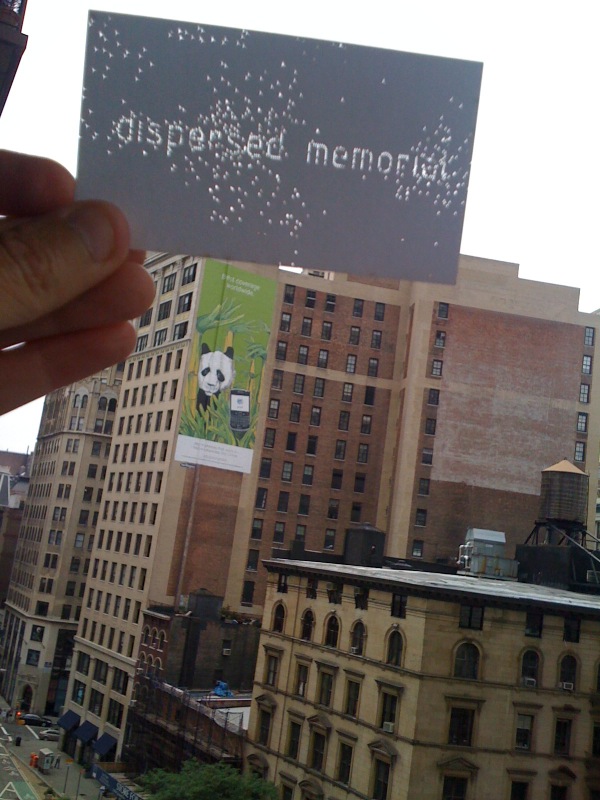
held by Kenny Snapp @ Broadway and 23rd St. NYC
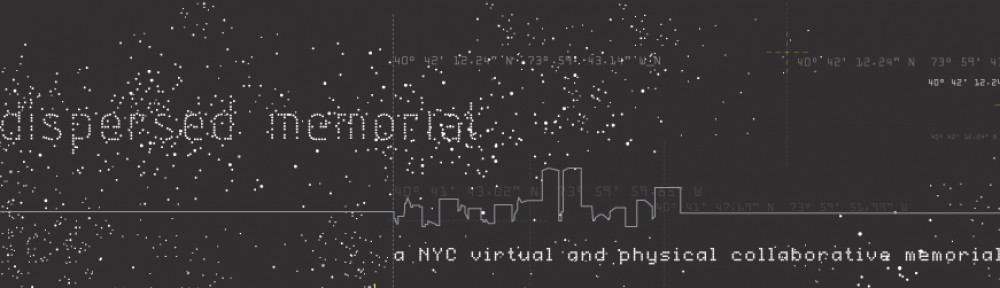
held by Kenny Snapp @ Broadway and 23rd St. NYC
Dispersed Memorial Project: Remembering 9-11 for Contract by Tara Andreas
“Rather than arguing about implanted bombs, shouldn’t this approaching milestone be more of an incentive to remember and honor the lives that were lost? ”
Thank you Tara Andreas View the review
Take a quick tour of the fabrication of the Dispersed Memorial cards! Before being dispersed throughout the nation, these cards were printed and laser cut in Charleston, SC. Each card contains hundreds of pixels cut to express the constellation like quality of the NYC 9/11 memorial. Find out more at http://dispersed-memorial.net


Through technology, light pixels and paper cards, Dispersed Memorial creates a country-wide collective remembrance of 9/11.
Each laser cut card reveals the project name through delicate voids in the paper, which create an ephemeral image only visible when the card is held to the light or casts a shadow. With each exchange of the card, a moment of remembrance is initiated and prompts a dispersed, collective conversation about the memory of loved ones lost or affected by the events of 9-11.

On September 11, 2010 fieldoffice launched an effort that will acknowledge lives lost during the tragedy of September 11, 2001 as well as reconstruct as many views of the city’s lost skyline. Thousands of glass plates, inscribed with a written dedication to a victim and an outline of the missing skyline, will populate New York City from anywhere in the city that the towers would have been visible. The project will be assembled online through the thousands of contributions from victims’ loved ones and residents or visitors of New York City. Our goal is to construct two conversing collective memorials, a virtual database of stories and images and the physical dispersed installation in the city, with two important deadlines at the 10th and 11th anniversary of the tragic events of September 11, 2001.

The organization of this memorial marks and celebrates the ephemeral and impromptu nature in which people lit candles simultaneously in the days following the events that took these lives, intersecting the everyday activities of the city as an organizational pattern that engages daily life. It also gives each victim’s family the opportunity to choose a specific location in the city to honor their loved one. In the surrounding urban landscape, families, city residents and visitors can engage with the seemingly infinite memorials that populate spaces of the city. Every night, the glass plates will light up one by one in a constellation-like choreography. Like lanterns lit from within, the plates will illuminate the inscriptions, cityscape, biographies, poems, and names that honors each victim, transforming into luminous, delicate, yet determined lines, filing the city in celebration and remembrance. As individual memorials on the urban landscape during the day and a constellation of lights on the city’s fabric at night, the plates institute a dispersed memorial. Another memorial emerges electronically, referencing each memorial’s location in the city and it is there where dedications and images are exchanged and mapped. With these two conversing memorials, physical and virtual the twining of the towers is re-instituted as one memorial – dispersed and centralized, individual and collective, ephemeral yet permanent, lost yet ever more present.